


This is the installment of an ongoing series exploring the history, psychology and culture behind one of the world’s most elusive ideas.
Everybody wants to be cool
´From San Francisco to Santiago, Sydney to Seoul, people want to be cool.´
That’s the first line of a paper published in 2025 in the Journal of Experimental Psychology. A peer-reviewed psychology study, opening with a sentence that reads more like the beginning of a travel essay than the start of a methods section.
What does it mean to be a cool person? Until now, I thought coolness was supposed to be instinctive. You know it when you see it. Trying to define it too carefully feels, somehow, like the fastest way to ruin it. And yet, a group of psychologists decided to do exactly that.

Todd Pezzuti, Caleb Warren, and Jinjie Chen asked more than 5,900 people across 12 to describe someone they considered cool. Worth noting: it wasn’t supposed to be some celebrity or any kind of influencer. Participants were asked to think of someone they actually knew; a non-famous person from their own life who, for whatever reason, struck them as cool.
But they didn’t begin by asking participants to define the word. They asked something much more interesting: think of someone you consider cool.
I like this methodological detail because it assumes something I hadn’t noticed before. Cool isn’t really an adjective. It’s a judgment. We don’t start with a definition and then go looking for people who fit it. We meet someone first, register a feeling almost instinctively, and only afterwards begin wondering what, exactly, made them seem so cool.
Good isn’t cool
Pezzuti, Warren and Chen also asked participants to think about someone they considered good, giving them a useful point of comparison. Here’s the thing: ask people to define cool directly and they tend to come up with a list of compliments. Something like “friendly”, “attractive” or “trendy”. That’s a definition of likable, not of cool. And raises the obvious question of whether cool is even its own thing, or just a fancier word for someone we already like.
Instead, they found six traits that were more associated with coolness than goodness: extraversion, hedonism, power, adventurousness, openness, and autonomy.
Some of these felt almost predictable. Openness, perhaps. Adventurousness. Even autonomy. They fit comfortably within our contemporary idea of someone who seems independent enough not to be living by other people’s expectations.
Others surprised me.
Hedonism, especially. Power, too.
They’re not qualities we usually admit to admiring, at least not explicitly. We tend to praise kindness, humility or generosity. Yet when people were asked to think of someone cool rather than someone good, they consistently drifted toward individuals who seemed to enjoy life, exercise influence, take risks, and occupy space with unusual confidence.
The more I looked at the six traits, the less they felt like a random collection of personality characteristics. Extraversion suggests visibility. Hedonism, a willingness to pursue pleasure rather than merely duty. Power doesn’t necessarily mean authority; it can be social, cultural or symbolic. Adventurousness implies comfort with uncertainty, while openness reflects curiosity toward people, ideas and experiences. And then there is autonomy, the quality that seems to sit quietly underneath all the others.
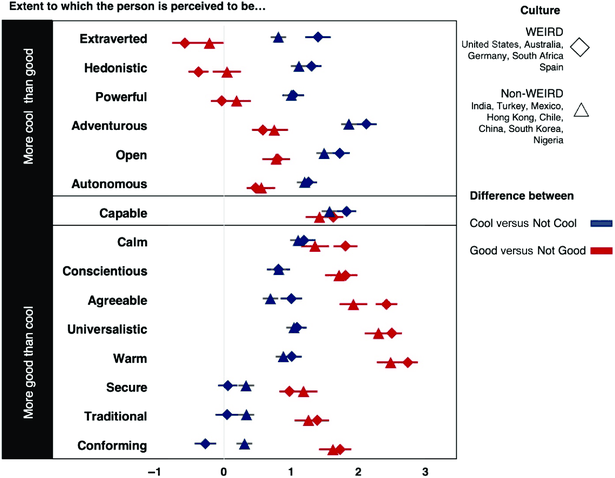
Cool people, in this data, were not necessarily nicer, calmer, more conscientious, or more agreeable. Those qualities belonged more comfortably to the category of good. Coolness seemed to ask for something else: a willingness to be open, adventurous, and autonomous; to seek pleasure; to have some degree of power; to be seen; to do things differently.
The researchers propose that coolness may function as an alternative form of status, one that rewards creativity, novelty, and the ability to challenge convention. The cool person is not necessarily the person who follows the rules particularly well. They might be the person who makes other people reconsider which rules were worth following in the first place.
On autonomy specifically
Caleb Warren, one of the study’s authors, had already spent years on autonomy before this paper existed. Back in 2014, he published a study called “What Makes Things Cool? How Autonomy Influences Perceived Coolness,” and later gave a TED Talk on the same idea, worth watching if you have fifteen minutes.
“The way people and things are cool is if they seem autonomous,” he explains. “They do what they want to do regardless of what other people think. But in a way that is appropriate.”
That word, appropriate, is doing most of the work. In the original study, Warren uses a rock band as an example. A band that skips writing the obvious single reads as cool. A band that rejects every single suggestion anyone makes, on principle, just becomes difficult to work with.
The same logic, it turns out, applies to all six traits. The 2025 paper makes a similar point about the others: someone visibly hungry for power stops being cool the moment their ambition becomes the obvious thing about them. Hedonism pushed past a certain point reads as recklessness, not pleasure. Cool, across every trait on the list, seems to require just enough restraint to make the rest of it look unforced.
A strange consensus
The researchers used the word “cool” across 12 countries with very different ideas about hierarchy, individualism, and how much a person owes to the group. And yet, the profile of coolness came back pretty consistent.
I found this almost as interesting as the findings themselves. I would have expected the concept to fracture across cultures with radically different ideas about status, success and individuality. Instead, the portrait remained stable. That doesn’t necessarily mean coolness is universal. It may simply mean that the contemporary idea of cool has travelled astonishingly well.
Extraverted enough to ask. Autonomous enough not to beg.
An unfinished question
What fascinated me about the study wasn’t that it offered a definitive answer. It was that every answer seemed to generate another question. If people around the world recognize cool in such similar ways, how did that happen? How does a word acquire that kind of cultural authority? And how did a word that once described composure become one of the most valuable currencies in fashion, music, advertising and popular culture?
If you’ll indulge me, I’d like to stay with this question for a while.
Over the next few editions, I’ll follow the idea of cool through language, psychology, history and, inevitably, fashion. Not because I expect to arrive at a single definition, but because some words become more interesting the longer you resist defining them. So, you should probably stay tuned.
While you wait
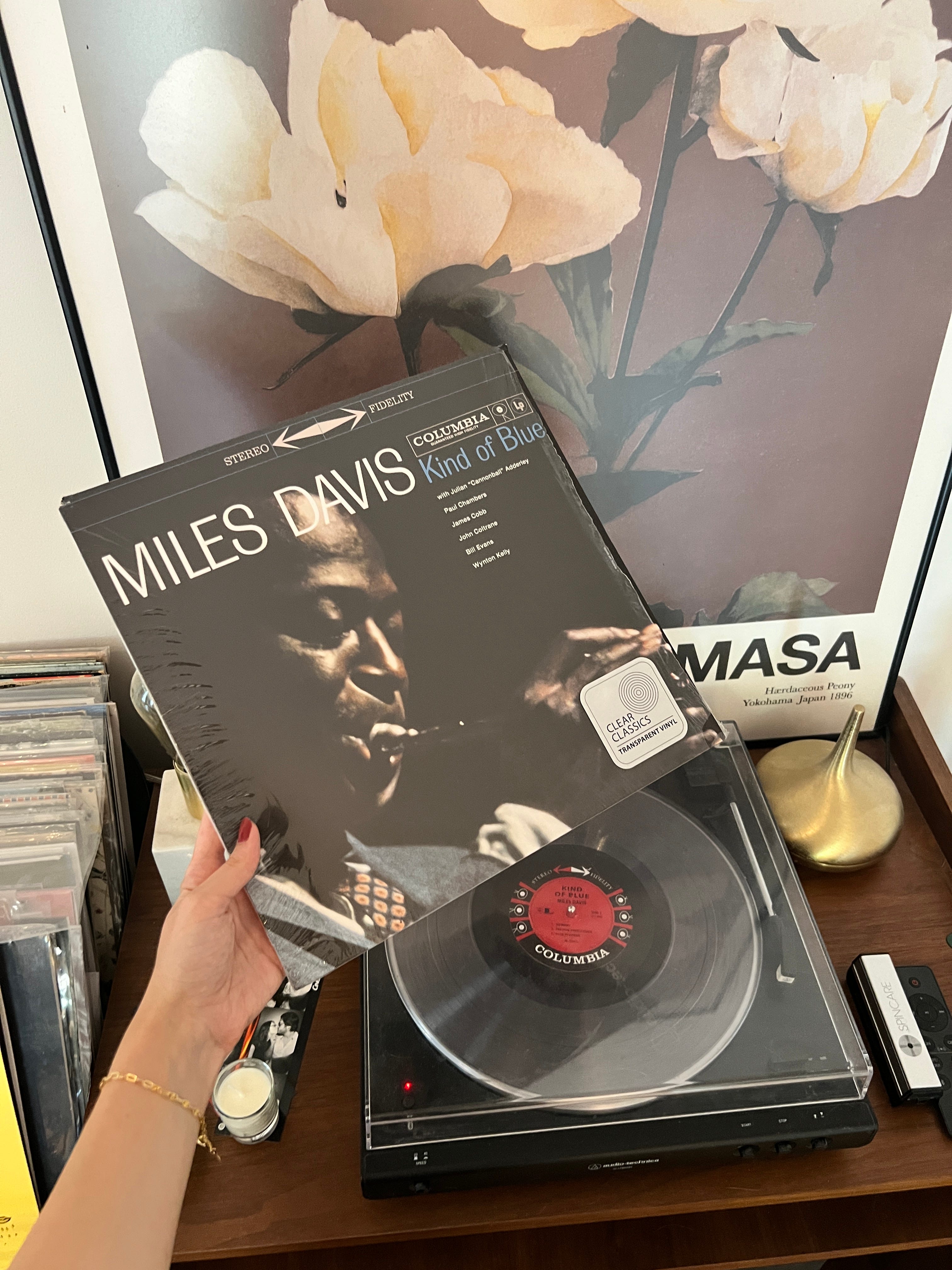
So what, you’re probably thinking, at a jazz recommendation in a newsletter about being cool. Which, coincidentally, is also the title of the song. So What, Miles Davis, Kind of Blue, 1959.
I mean. So What. Even the title shrugs.
And if you’re as performative as I am, you’ll want to listen to it on vinyl.
Thanks for reading.
You didn’t have to make it this far, and yet here you are, extremely open, mildly autonomous, and — I’m just going to assume — a little hedonistic about how you spend your Monday mornings.
Cool of you.
Julia